Built for complex grocery operations.
Harris Farm Markets
Location-aware Shopify foundations for high-volume grocery.
Harris Farm needed Shopify logic that could understand where a customer shops, what is available to that store, how pricing should resolve, and how those decisions carry through cart, checkout, and customer accounts.
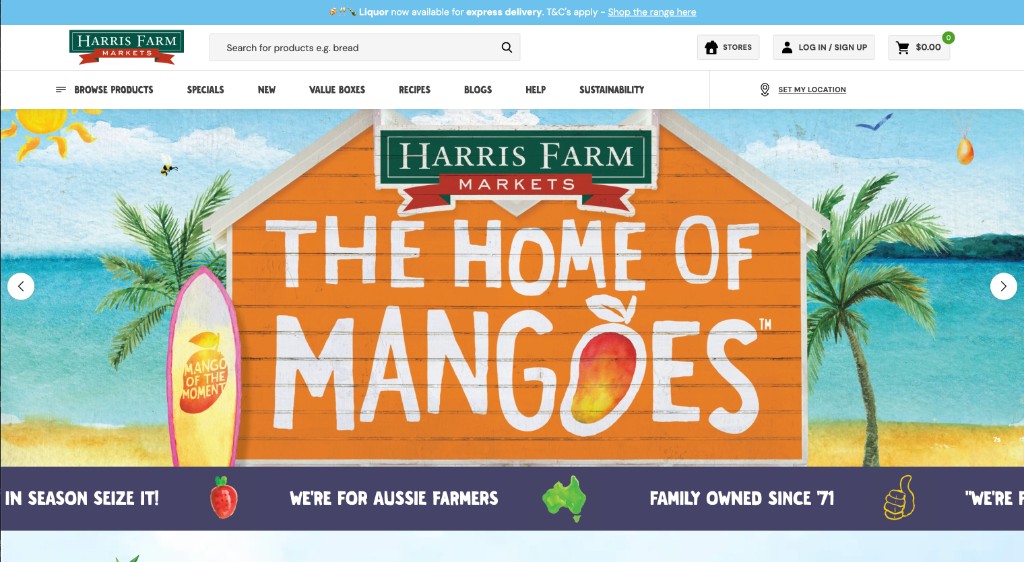
Store-aware product availability from the start.
Location-specific pricing without variant bloat.
Logic carried through cart and checkout.
The challenge
Grocery needs more than a standard product catalogue.
Harris Farm operates with a level of complexity that most standard Shopify builds never need to consider. Store selection affects availability, pricing, fulfilment logic, customer experience, and the way the cart needs to behave.
The previous approach was variant-led. The selected picking store was read on the frontend, then pricing was updated by matching against variants created for each store. It worked, but it created operational overhead and made future functionality harder to build cleanly.
The newer architecture moves the system closer to Shopify's native model: use Shopify Locations for availability, then layer pricing and cart behaviour through structured data and checkout-safe logic.
Architecture shift
From variant-per-store workarounds to location-aware commerce logic.
Pricing depended on variants that matched the selected picking store.
Availability resolves from the right location as soon as the experience loads.
Structured pricing and business rules can carry through cart and checkout.
What we built
A commerce system that understands the customer's store context.
Location-aware loading
The storefront loads against the correct Shopify Location from the start, instead of treating store selection as a later frontend patch.
Availability from Shopify Locations
Product availability can resolve against the selected store or fulfilment context using Shopify's location model.
Pricing through metafields
Location-specific pricing can be stored as structured metafield data, avoiding the complexity of a variant for every store.
Cart and checkout logic
Cart Transform can carry the same business rules into cart and checkout, keeping frontend behaviour aligned with the final order.
New customer accounts
The same location-aware foundation can support account experiences, repeat shopping, saved preferences, and future personalised flows.
Future-facing sales channels
Once location context is reliable, it opens the door to upsell, cross-sell, lists, and AI-assisted cart experiences.
Why it matters
This kind of work is less about a single visual feature and more about the architecture behind the commerce experience. When availability, pricing, customer context, cart logic, and checkout rules share the same source of truth, the storefront can support much more complex buying journeys without becoming fragile.
Have a complex Shopify system?
Let’s make the logic behind the store easier to scale.
Bring us your storefront, workflow, integration, or growth problem. We will help find the highest-impact path forward.